
Big Cat Attacks Throughout History (The Dark Side of Circus Life) - Chapter I - Louis la Tour

As you know, Halloween, for me, is not a time for gore, mayhem, and the chaos of violence, but one of inward calm and connection. For is in the autumn of the year that the veil draws thinnest, giving us glimpse, if we’re attentive, into the world of soul and spirit. Today’s post, therefore, should not be considered a cheap ‘horror show’ - but rather one, I hope, which leaves us to contemplate how to get a hold on the wilds of the animal nature within us and turn its power, through wisdom and patience, into a calm and steady grace.
Thankfully, the era of the ‘Big Cat Circus Show’ is largely coming to an end. Here is a spectacle which can boast no purpose or evolution beyond the thrill of danger - the palpable frenzy of wild animal power pitted against defenseless humans, armed only with their wits and accompanied by the absurd and flimsy trappings of costume and routine. Enslavement? Domestication? Man as master of the world of nature? The whip cajoles rather than commands, the trainer - ever conscious of his hapless state, belies the fact in his bearing no matter how bold the gesture. And then there are the attacks - the stories and lessons of which undoubtedly blazed in the minds of trainers and spectators alike when confronted by these gargantuan predators. Ultimately, and tragically, it was these lesson alone - taught into the bodies of far too many talented and well-meaning men - that finally put an end to the profession of the “Lion Tamer.”
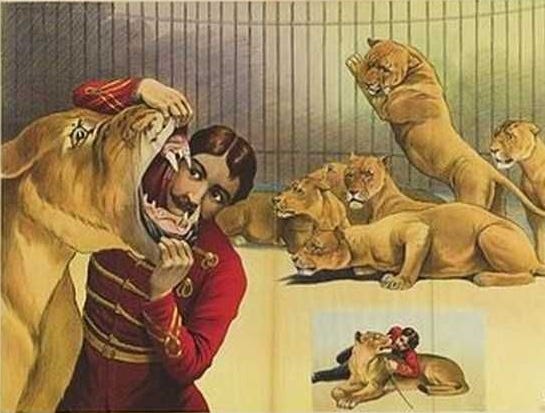
Louis la Tour (loo-ee la tore) was the first internationally recognized lion-tamer of the Industrial Age. Our story finds him at the height of his fame and poised to demonstrate his art to the world for his home country of France - the soon-to-be host of the 1889 World’s Fair. He arrived at a point in French history when such a hero, as he became, was sorely needed. France had suffered military defeat and humiliation, was losing badly to Germany in industrial competition, and the government lacked direction, identity, and respectability. Despite these circumstances, French culture thrived and was the envy of the world. There was no arena of art - practical or theoretical, in which France did not outdo European or American rivals except perhaps in the enterprise of the circus. For over a decade, the name “Barnum and Bailey” had epitomized the genre and was the first on anyone’s lips when it came to innovation, spectacle, and, of course, in peddling the thrill of danger.
As a lad of but five year’s old, Louis had sat under the ‘big top’ of a traveling circus that had set up in Paris during summertime and had witnessed a sensational lion tamer’s performance. He later recalled - ‘This was beginning. Before the science of psychology and evolutionary theory informed the art, it was the province of gypsies whose grip on the mind of the cat stemmed more from mesmerism and the mystical than method and rapport.”
Before long, Louis was practicing his own routines on stray cats that he found in alleys and abandoned hovels of Paris. Only once did he receive a notable scratch but it taught an important lesson - “After the strike, the animal leaves open a small but critical window of time allowing for a counteraction from the master. She is guilty - hesitates - something in the nature of beast is aware of the affront her action perpetrates against the soul of the superior being.” The style that La Tour developed was rooted in the now-debunked pseudo-scientific “metaphysical implications of Hebert Spencer’s theory of natural selection.”
Louis hailed from a comfortable bourgeois family and entered university life with the trajectory of one destined to speak at the head of a classroom, to listen at the side of the couch of the mentally challenged, or behind a desk in the lab of innovation. La Tour, however, studied the workings of the mind and its connection to nature for the singular purpose of mastering animality in its most formidable form. His intention was none other than to write the world’s greatest practical and theoretical treatise on the subject of ‘the scientific mind’ as the pinnacle of achievement atop all other creations of nature. Sadly, only fragments of his notes remain - his diaries fraught with the intrigues of circus politics - consumed with drama betwixt more than a dozen mistresses (whose fixations and misadventures could fill volumes on their own).
Part scientist, part athlete or strongman, part performer, all-man, Louis entered official employment as a Lion Tamer with the traveling company of the ‘Cirque de Rue’ in the year 1885. What he found initially was a wholly undisciplined and chaotic affair, especially in the culture of big cat entertainment. “They wished to pair me, as trainer, with a farcical tart of woman - a red-headed Irish (Scottish - editor) can-can girl who pretended to treat the giant predators with the same manner as a granny handing out treats to a litter of kittens.” Though relegated to a ‘musical seals act’ this ‘tart of a woman’ would ironically return to replace La Tour at the World’s Fair some several year’s later.
The next challenge Louis faced concerned the general stock of lions themselves. Considering male lions far too dangerous to work with, Cirque de Rue had taken to employing lionesses affixed with false mains to make them appear more formidable. La Tour was disgusted - “(The circus) …wholly focused on the Jew’s art of making money, pays no attention to the realities of nature or the culture of man.” The wigs were soon dispensed with and two huge male lions were purchased from an Algerian menagerie (Samson and Sanson (means ‘no head’ - as in ‘cut off’ in French)). He then set to work applying his wholly differently-learned techniques emphasizing the ‘stick over the carrot.’
The later criticized and abandoned methods were initially hailed and widely imitated - Louis would literally ‘rattle the lions’ cages and tease them into exhaustion.’ He timed this rough medicine with feeding, exercise, and sleep schedules so as to condition his subjects to accept the futility of acting out in the course of their performative routines. Twentieth Century analyst, Gerard Barre, states - ‘La Tour wished to impose the factory life on his lions - for a period of time he succeeded - they punched in their time on the clock, ate, slept, and went to church all on a schedule - then one day the jungle re-awoke within them.’
Louis constantly complained about the budget he was allowed to work with. It was never enough to fund real change or innovation. After more than 50 performances in his first year, the circus troupe still struggled to cover the expenses of the trainer and the bills for the animal’s food, maintenance, and healthcare. Then, late into the second year, disaster struck. The summer of ‘87 was one of putrefying and stifling heat - Samson, the lion, developed an abscess under a tooth on his lower-left jaw, initiating a costly and time-consuming treatment. While la Tour took time off for the lion’s recovery, the circus group sought to keep expenses down by conducting in-house chores more efficiently. It was decided that the troupe’s wee-people (the exploitation of disadvantaged peoples was a common practice in 19th Century France as well as across Europe and in the United States) - the so-called ‘Elfes du Merde’ (the ‘Seine Sewer-Goblins’) would feed the cats.
When the lion-tamer returned some days later to resume work, he was incensed by what he found - ‘Did the lions think they were being fed by men, children, or by monkeys? Our customs - a host of artificial contrivances - do nothing to inform the beast - lions understand deeds - they understand what nature tells them through scent - what does it tell them if monkeys bring them their food? I cannot but think this has had a bad effect on the hierarchy that I have worked so hard to establish.’ La Tour had become heavily influenced by the now discredited theories of ‘phrenology’ and ‘racial typing or hierarchy’ based on the fantastical belief of mythical Atlantis. Regardless of the motive, la Tour’s solution was to reassert his physical authority which, in retrospect, was dubious, if not outright abusive.
Again, Barre informs us “They were behind in shows and revenue, tensions were high, the heat was unbearable, - Samson - (the lion)’s, wound was painful and gave him the countenance of a weak and suppliant cat (some say C.S. Lewis was inspired to portray the ‘defeated Aslan’ from Samson’s description given by contemporary newspapers - editor). But infirmity was anything but Samson’s plight - true his coat had lost its sheen, he walked as if to sidle off the pain to one side - but like the other wounded Samson - he had all his power.” Nonetheless, circumstances led to a climate of frustration and lashing out by both trainer and the trained. (In addition to circumstances outlined above, la Tour, was suffering with more private concerns and even disease (in the previous summer, Louis had contracted syphilis from the famous Parisian courtesan who haunted the literary salon of Anatole France, and went by the name “Marie Antoinette.” The details are beyond the scope of this post, but these events also involved Louis in the ire of a “jealous John” and he had but narrowly escaped having to accept a challenge of a duel of swords. He was also rumored to have suffered and survived a bout of rabies contracted from the bite of a weasel that had been eating fodder and dung in the shadows of the circus stalls)).
The fateful day came - August 22nd, 1887. Inside the circus tent the atmosphere was so dark and hot only one strange adjective (that the newspapers seemed to use in concert) could describe it properly - it was “Saturnian.” Initially ‘aqua-girls’ were deployed to greet patrons with a splash of water or ladle out shares of it as the audience was seated - but this only seemed to introduce more steam and dour mood into the atmosphere.
The audience cheered the entry of the clowns as the circus began, but the initial gaiety soon seemed to degenerate into howls of annoyance and derision - nothing could be done- no breeze could be stirred up and into the vacuum of the circus forge. The drone of the organ - the macabre faces of melting clown makeup turned the scene into that of Hell itself.
The only act in the day’s affair that seemed to relieve rather than oppress was ‘Tara the Seal-Woman’ (the “red-headed ‘Irish’ tart”) who bathed among her silly animals almost as naked as they, frolicking in sprays of water and honking horns. But the mirth was short-lived and faded instantly with the closure of act.
Then came the lions.
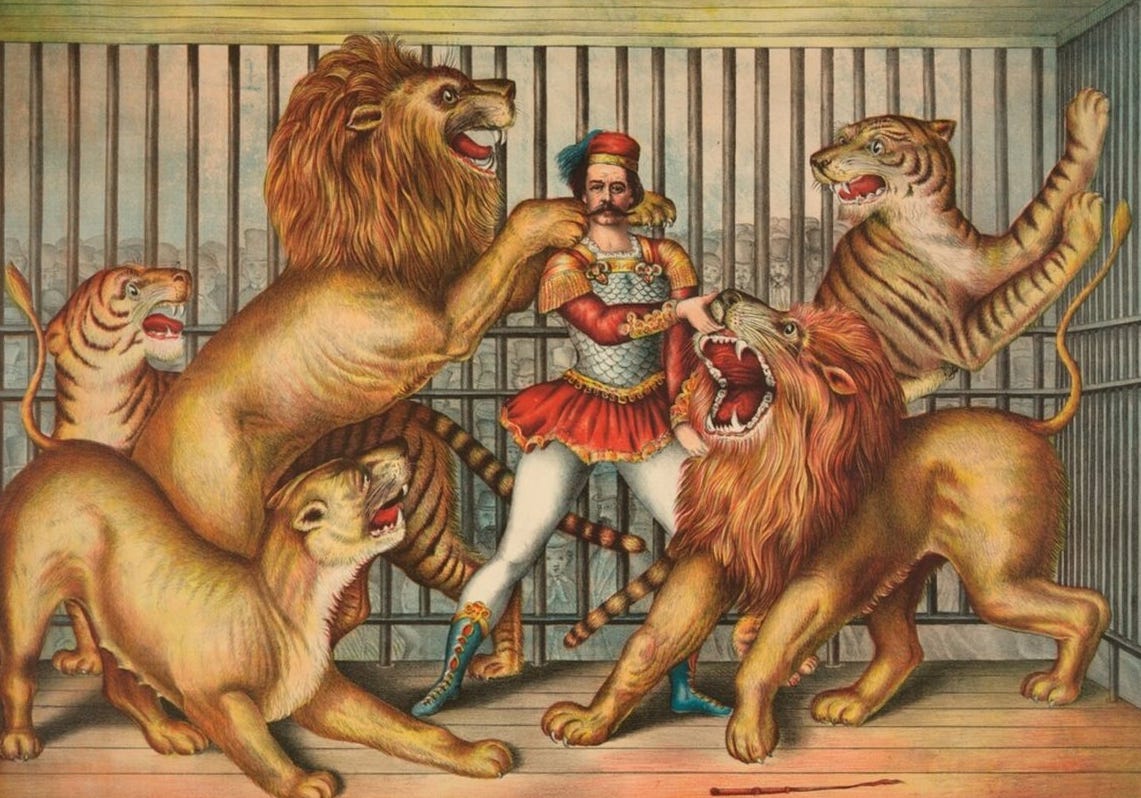
Louis la Tour was performing for his 87th time - coincidentally the same number of years his century held. He was dressed as a Roman Gladiator - come to fight and conquer the lions in an arena that was his. Here was no victim meant to be fed to snarling beasts like some quaking Christian, but Man, as Triumph itself, riding atop of His greatest creations of Industry, Empire, and Science. The lions, representing the conquered world of nature, seemed to rage against their bonds.
Samson and Sanson were wheeled in in separate cages from opposites sides of the ring, roaring and hissing at the height of aggressive agitation. Driven wild by the heat and the palpable funk of angry men’s souls their tails twitched, eyes and teeth flashed, making every gesture one of explosive release from what consumed them from within. Their focus was entirely on la Tour. In no uncertain terms - their menacing announced that they were not to play games this day - these were twin kings of the jungle and done doing the taking.
The audience was instantly struck dumb without discernible character or emotion.
Louis himself was a mighty ball of rage and pain - and he suffered a type of frustration known only to the intellectual - as mind collides against the idiocy of world. His tights, wool and thick, were a menace to his syphilis-besieged loins. His paper mache armor - his Roman ‘lorica segmentata’ was sweating out glue - giving it an appearance of rusting at the seams, under his thick hair and mustache his flesh seethed and oozed salty brine stinging his eyes and mouth.
His two assistants - foreigners with whom he could only speak through sign and symbol, were alternately beseeching and warning him to somehow turn around - somehow avoid the opening of the cage, but Louis’ eyes were fierce, defiant, insistent - he had already cast aside cape and cudgel (a reference to Hercules, the semi-divine hero of strength) and stood defiant before his fate.
The doors were flung open simultaneously and the huge lions tore out from their cages nearly inciting a panic amongst the audience. Louis - perhaps in a perversion of passion, was seized by an equal impetus to attack and punish and rushed at Samson the wounded monster. Man’s ego commands startling power when seated with authority in the soul, but in his conflagration of passion, la Tour lost himself. It was the lion who checked his momentum and traded-down bodily collision for a quick parry of a nearly velveted paw.
To be sure, there was enough claw exposed to punctuate its claim. The crowd transfixed, stirred not, as several small channels of blood opened in obscene contrast to the powered white face of the knight. But it was done and over like a faraway flash of lightening - if the rest hadn’t happened, the crowd might not have risen, nor trainer be compelled to retire - the blood, while it flowed, did not blind nor make a public show of itself.
It was la Tour’s training that ultimately undid him. The window of time - it opened - in front of him sat a lion now appeased, the other - behind and unobserved- closing for attack. If Louis had had full possession of his wits he would have pivoted with purpose to meet the danger to his rear. But woe! Louis was not of a mind to compel and command, but to strike and punish!
Fueled by rage, the master lashed out with his Turkish whip and landed a cracking blow across the soft pink target that was Samson’s regal nose. He marked it with a new cleft between the beast’s nostrils and saved no sense for himself but to behold the result. Male lions rarely attack in concert - it was not in aid or defense of Samson, but for his unchecked momentum that Sanson struck.
The crowd now found it voice in collective gasp as the lion tamer’s feet were brutally batted out from underneath him. Hard and heavy he hit the dusky floor landing roughly in a jumbled heap. Athlete he was, however, and Louis righted himself in one mighty contraction - gained his feet in a trice, and readied himself for the instantly escalating mortal danger. For years after, new lion tamers would carry a loaded revolver in their whip-hand - and old-hands - with the holstered weapon on their hip - this would have been the time to use it - nothing short of speedy death could stop the savagery of that moment when Hell broke free in Paris.
With his back now to split-nosed Samson, animal savagery took over. The lion pounced with outstretched paws striking la Tour’s lower back and producing an action upon the man reminiscent of a long bow whose string was suddenly cut. The ground received la Tour’s body - cruelly unyielding- against the tremendous release of force compounded by gravity.
Samson’s massive figure now perched on the back of his prey like an over-sized bird balancing on a thin stick. Then, in a movement memorable for its horrific admixture of grace, power, and sadistic feline operation, the animal curled over top the victim and planted his canines fully around and into the head and skull of Louis la Tour (a gesture one occultist later described as a ‘hellish embodiment of the zodiacal sign of Cancer (la Tour’s birth sign). It was meant to grip, not kill, though the autopsy report revealed that fully three of the lion’s canine teeth punctured the man’s skull and the pressure cracked and fractured the rest so badly as to produce a wound few could hope to survive.
"Decapitation” was not the right word. Though no newspaper dared an illustration, 'Le Monde’ described it unflinchingly - ‘the beast, having his master secured in a death grip, pulled up and back on the man’s head - instantly and audibly breaking his spine in at least two sections until there was nothing more to yield but the prize itself. The lion pulled the head clean off of him - the spinal column right out him - with the bundle of nerve-cords, and fluids following.’ That said, it was the sound of it that haunted the pitiable audience all the more. Various attempts and contests emerged to describe the moment of it - of what part mechanical, what part bestial, and yea, what part of man’s share was in that abysmal sound. In the end, what was heard, if you can stomach it, gave us the expression we still have today - Louis la Tour “croaked.”
Of the two known lion trainer’s mistresses in attendance that day, both fainted from witnessing the atrocity, and one - Cecelia Antony Vincenzi, went into instant menopause some two decades too soon. The crowd panicked and fled. Many of the animals caught up in the frenzy, stampeded, and added to the riot carrying out into the streets. It took Paris police and municipal workers more than 17 hours to restore order to the city.
It seems only the lions in this affair were afforded a peaceful fate. While ‘the justice of the jungle’ seemed to demand the euthanization of both, the lions attracted the attentions and curiosity of none other than the King of Belgium - who purchased them with a handsome sum of diamonds. Cirque de Rue, now in financial arrears, could hardly refuse.
And so we draw our post to a close, dear reader. Let us not for long dwell on the awful aspects of this story, or look too deeply for lessons to be found in the depravity of the dark and wild, but rather turn our thoughts once more to the lighter and brighter aspects on which humanity also touches. For surely we can sigh contentedly together knowing the past is past. Indeed, for all the marks and scars the empires, sciences and industries have left on mankind, it all turns to one easily wiped away and disposed of greasy smear compared to the education and ennoblement of soul that the arts and rich social life have afforded us.
Stayed tuned for chapter two when we investigate the horrors of the ‘Tiger-Tamers of the Third World.’
R.I.P
That was a great story, well told. A real Halloween tale of horror. I never heard the story. All the lion attacks I heard of were from more modern times and periodicals. Mostly limbs torn off. So gory, skull crushed, decapitated with his spine pulled out. That way beats what happened to Roy.